Why Does EMDR Work?
Last reviewed: 2026-09-12 · Editorial source check
Evidence that a treatment helps and evidence explaining exactly how it helps are related but different. EMDR has substantial research support for PTSD, while its mechanisms continue to be studied.
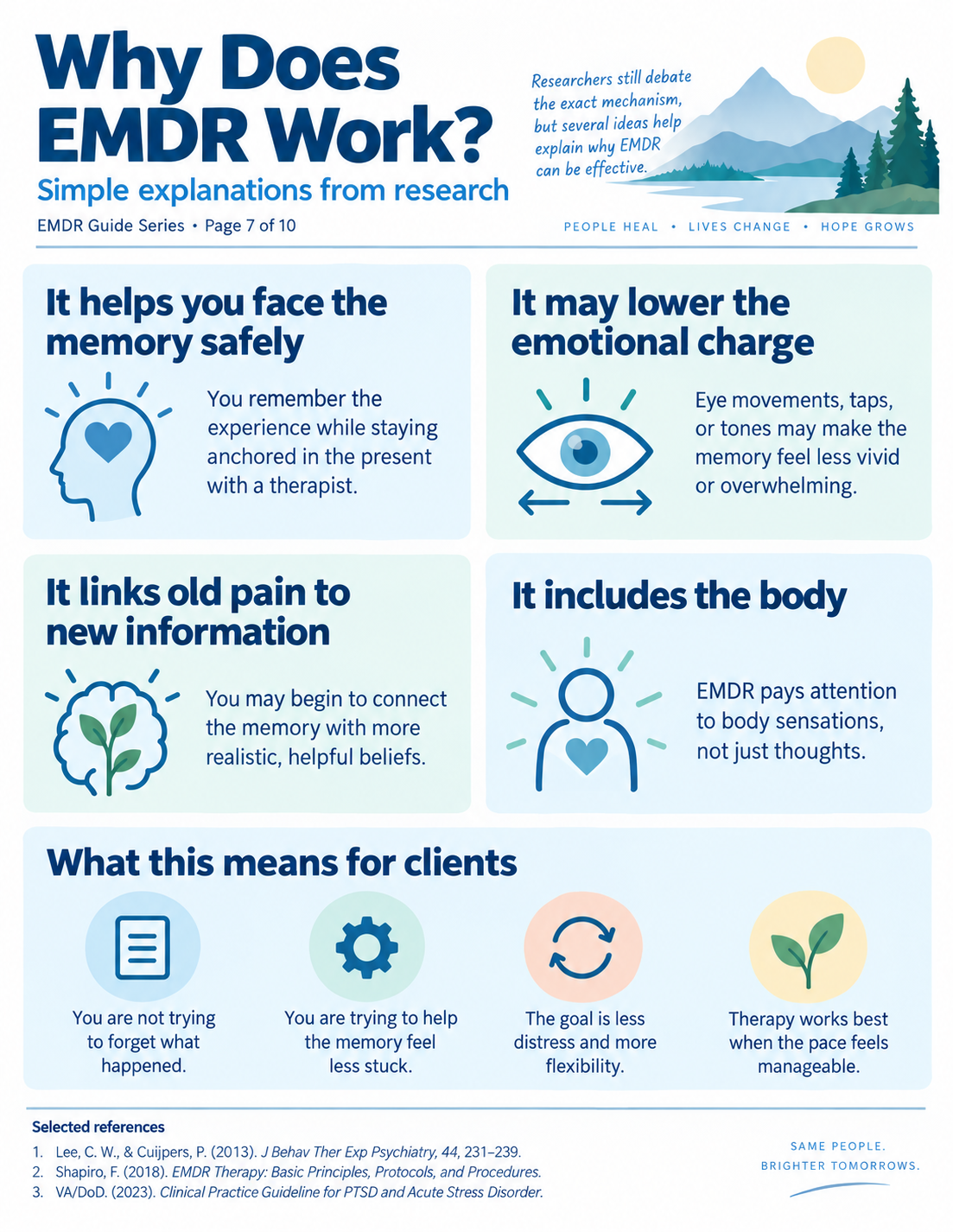
The graphic introduces proposed explanations. Read its brain and memory language as a simplified model, not a proven account of what happens in every person's brain.
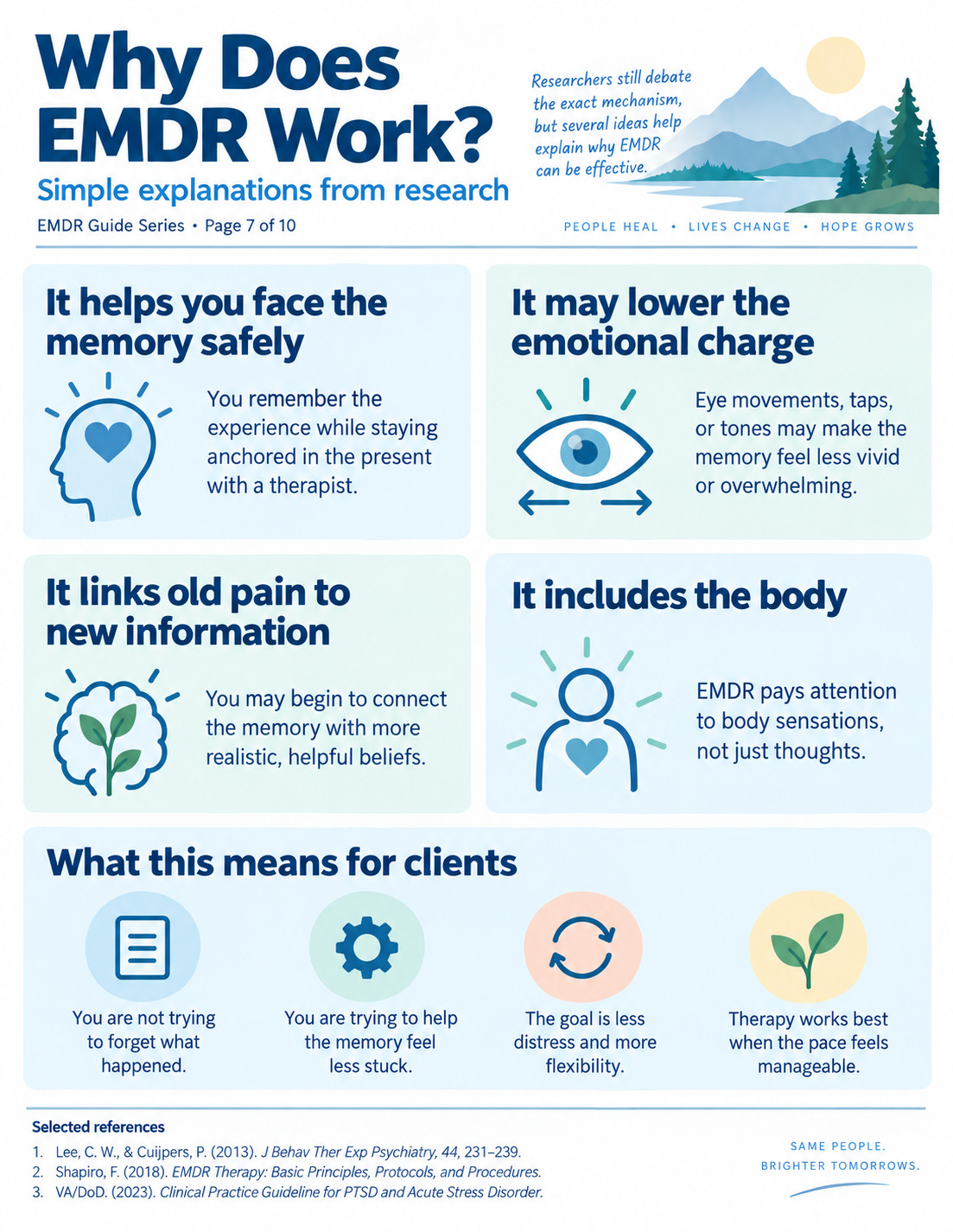
What this guide explains
One line of research examines working memory: the limited capacity involved in holding and manipulating information at a given moment. Remembering an emotional image while doing another task may compete for that capacity. Experiments have examined whether this changes how vivid or emotional a memory feels. These findings are relevant to understanding eye movements, but a laboratory memory task is not the same as a complete course of therapy.
Other explanations emphasize attention, learning, and changes in how a distressing experience is understood. The adaptive information processing model provides a clinical framework for EMDR, but a framework should not be presented as direct proof of a specific neural process. More than one process could contribute to treatment effects.
For a client, the practical question is not whether you can memorize a mechanism. It is whether your clinician can explain the proposed treatment, its evidence, and how progress will be monitored. For clinicians, careful psychoeducation can hold both ideas together: EMDR is a supported option for PTSD, and no single explanation has settled every question about how it works. Visual bilateral stimulation tools support delivery; they are not independently validated substitutes for psychotherapy.
At a glance
- Treatment outcomes and mechanisms are different research questions.
- Working-memory competition is one proposed explanation.
- Laboratory findings do not fully explain clinical change.
- Brain-hemisphere and memory-erasure claims are oversimplifications.
- A browser BLS tool is not the full EMDR treatment.
What the research says
Lee and Cuijpers' meta-analysis examined the contribution of eye movements to processing emotional memories. It supports studying this component, but it does not establish one complete mechanism or product-specific efficacy for EMDRdot.
How to read the evidenceReferences
- Lee, C. W., & Cuijpers, P. (2013). A meta-analysis of the contribution of eye movements in processing emotional memories. Journal of Behavior Therapy and Experimental Psychiatry, 44(2), 231–239. doi:10.1016/j.jbtep.2012.11.001Meta-analysis
- National Center for PTSD. Overview of Psychotherapy for PTSD. Summary of the 2023 VA/DoD guideline.Clinical guideline summary
- Shapiro, F. (2018). Eye Movement Desensitization and Reprocessing (EMDR) Therapy: Basic Principles, Protocols, and Procedures (3rd ed.). Guilford Press.Treatment manual
Selected sources checked for identity and relevance. This is an educational summary, not a comprehensive systematic review or a claim of independent clinical review.