Can EMDR Help With Depression?
What research suggests about depressive symptoms, Major Depressive Disorder, and Persistent Depressive Disorder.
Last reviewed: 2026-09-12 · Editorial source check
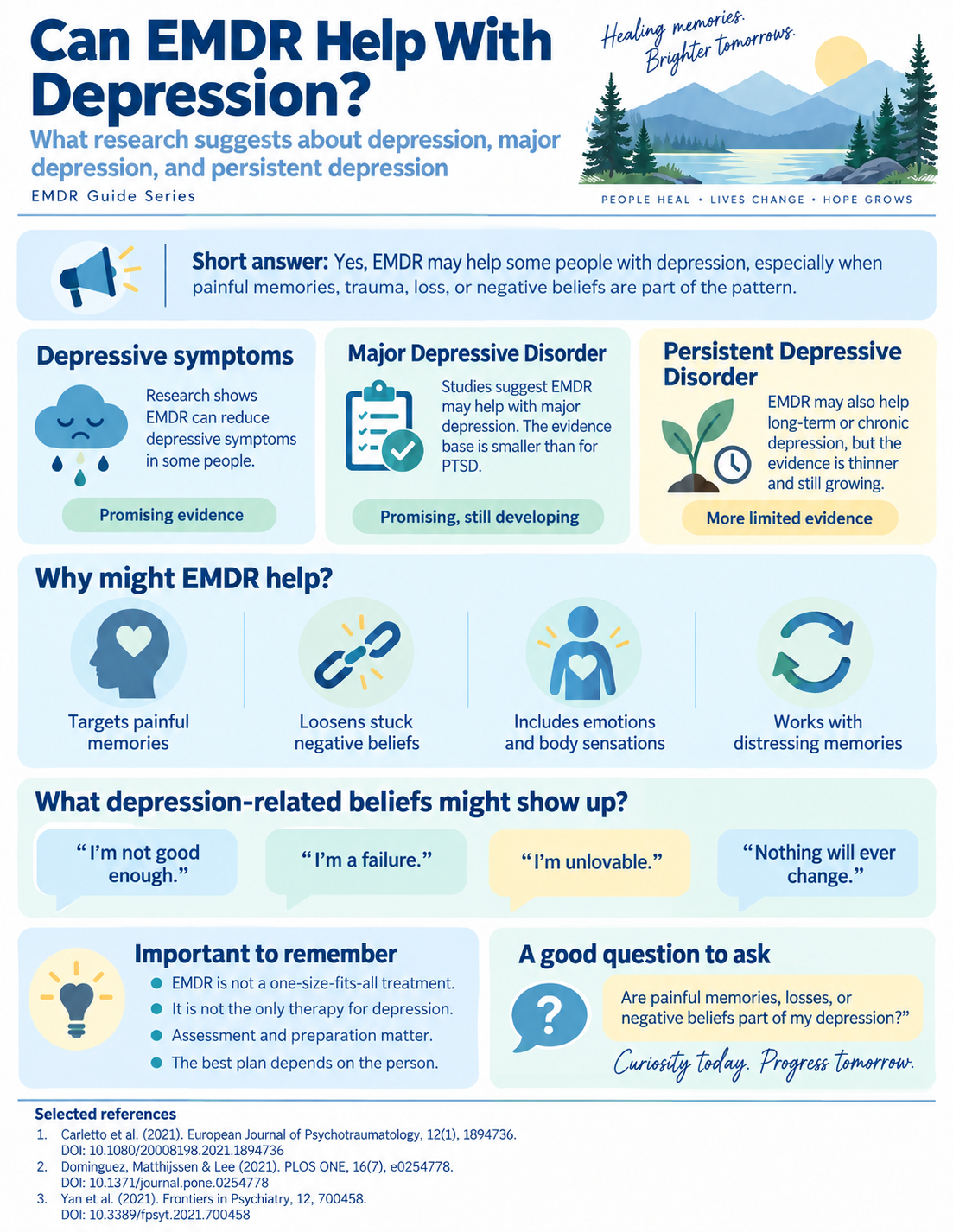
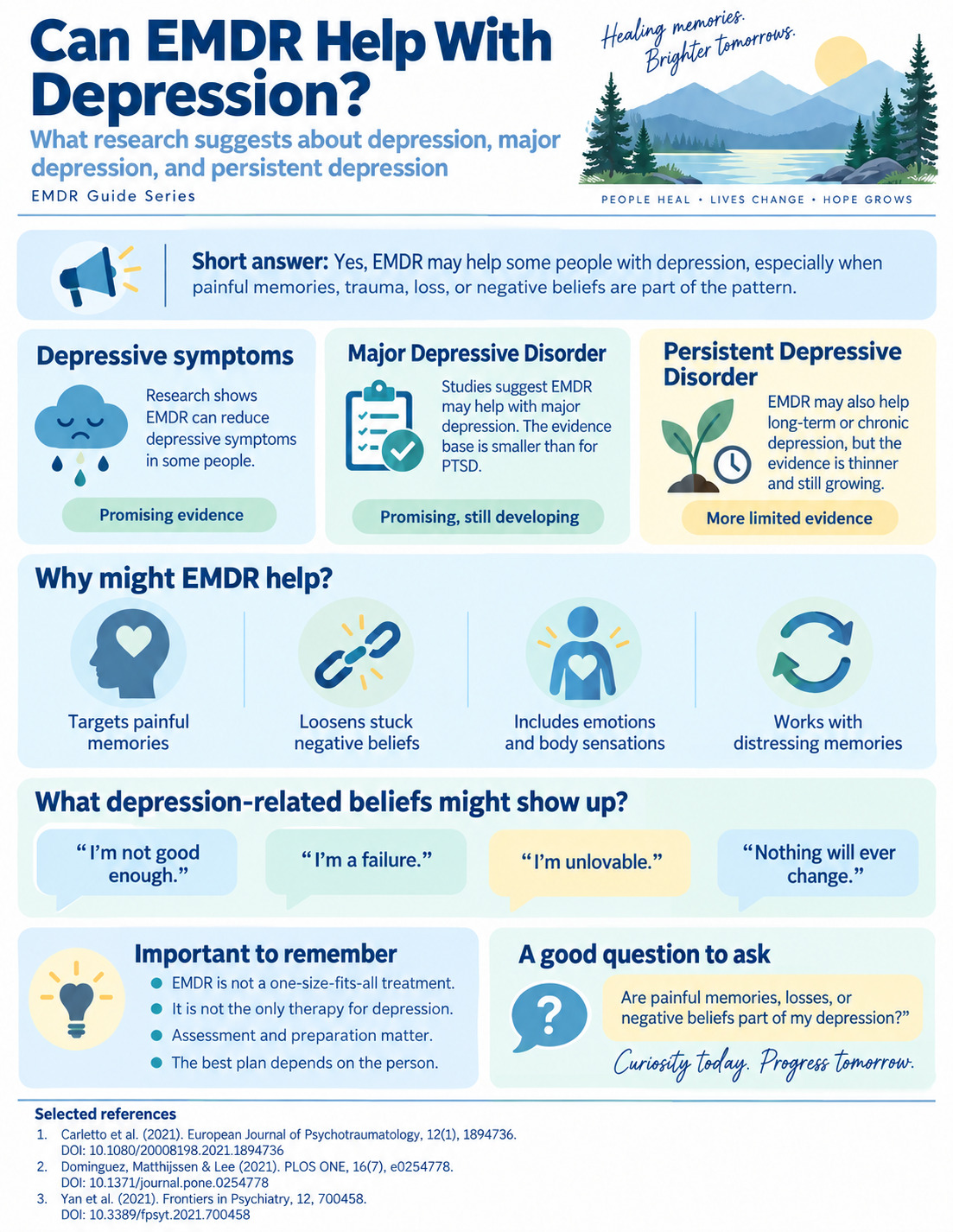
Research suggests EMDR may reduce depressive symptoms in some people. That possibility deserves attention without turning it into a claim that EMDR cures depression.
Depressive symptoms, Major Depressive Disorder (MDD), and Persistent Depressive Disorder (PDD) are not interchangeable study populations. This guide keeps those distinctions visible.
What this guide explains
Depressive symptoms can be measured in many kinds of studies, including studies where depression is not the primary diagnosis. An improvement on a symptom questionnaire is useful information, but it does not by itself show that a treatment has been established for every depressive disorder. Ask who was studied and what other care participants received.
Research examining EMDR for Major Depressive Disorder is promising, but the evidence base remains smaller than the evidence for PTSD. A meta-analysis of randomized MDD trials rated certainty as low or very low for its outcomes. Small studies, differing comparison groups, and risk of bias limit how confidently results can guide a broad recommendation.
EMDR may have potential for chronic or persistent depression, but evidence specifically addressing Persistent Depressive Disorder remains comparatively limited. Chronic symptoms and a formal PDD diagnosis should not be treated as identical in a research summary. A therapist can discuss whether distressing experiences are relevant within a broader assessment and compare EMDR with other treatment options. This resource does not present EMDR as established first-line care for depression or suggest changing medication or an existing treatment plan on the basis of a handout.
At a glance
- Depressive symptoms: some studies show encouraging reductions.
- MDD: promising findings, with a smaller and lower-certainty evidence base than PTSD.
- PDD: diagnosis-specific evidence remains comparatively limited.
- A treatment choice needs individual assessment and discussion of alternatives.
What the research says
Three 2021 reviews report encouraging findings but differ in their scope. Carletto et al. examine EMDR for depression; Dominguez et al. examine trauma-focused treatments; Yan et al. focus on randomized trials in adults with MDD. These are selected evidence summaries, not a claim that all later research has been systematically reviewed.
How to read the evidenceReferences
- Carletto, S., et al. (2021). Eye movement desensitization and reprocessing for depression: a systematic review and meta-analysis. European Journal of Psychotraumatology, 12(1), 1894736. doi:10.1080/20008198.2021.1894736Systematic review and meta-analysis
- Dominguez, S. K., Matthijssen, S. J. M. A., & Lee, C. W. (2021). Trauma-focused treatments for depression. A systematic review and meta-analysis. PLOS ONE, 16(7), e0254778. doi:10.1371/journal.pone.0254778Systematic review and meta-analysis
- Yan, S., et al. (2021). The Effectiveness of Eye Movement Desensitization and Reprocessing Toward Adults With Major Depressive Disorder: A Meta-Analysis of Randomized Controlled Trials. Frontiers in Psychiatry, 12, 700458. doi:10.3389/fpsyt.2021.700458Meta-analysis of randomized trials
Selected sources checked for identity and relevance. This is an educational summary, not a comprehensive systematic review or a claim of independent clinical review.