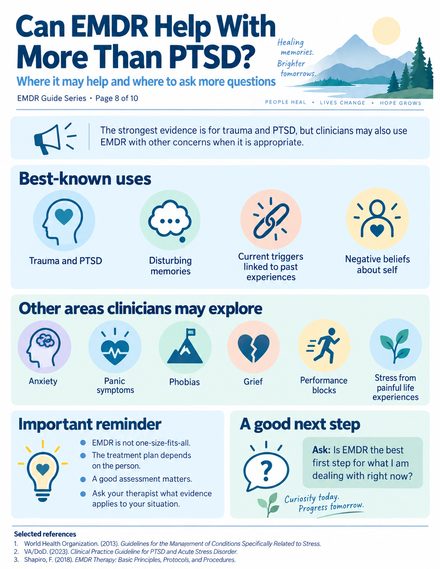
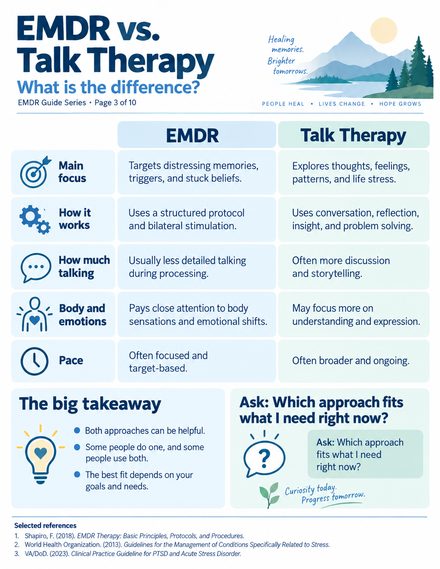
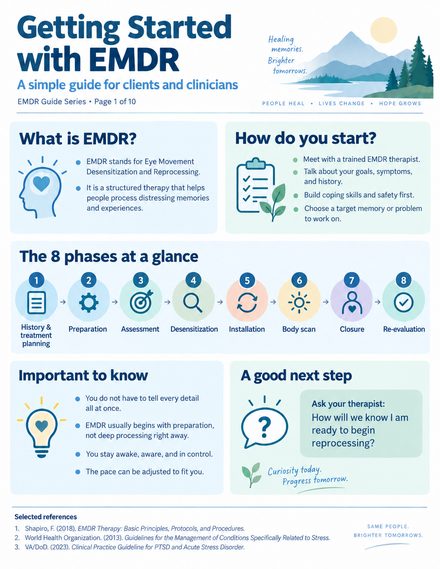
EMDRdot Monthly
Research · Practice · Resources
Can EMDR Help With Depression?
Welcome to the first web edition of EMDRdot Monthly. This month starts with a question that deserves more than a yes-or-no answer: can EMDR help with depression? A headline can make a developing research area sound settled, while a skeptical response can dismiss findings that are worth understanding. A useful conversation leaves room for both possibility and uncertainty.
Our focus is on reading the evidence carefully and explaining it clearly. We will distinguish depressive symptoms from specific depressive disorders, consider what a therapist might ask, and share a guide you can read together. None of this requires assuming that every person's depression comes from trauma.
Research Spotlight
What was studied?
Three systematic reviews published in 2021 examined overlapping questions about depression and trauma-focused treatment. Carletto and colleagues reviewed EMDR for depression; Dominguez and colleagues examined trauma-focused treatments; Yan and colleagues focused on randomized trials involving adults with Major Depressive Disorder. These are selected research highlights rather than a claim to cover every study published since then.
What did the research find?
- The reviews reported encouraging reductions in depressive symptoms in the studies they included.
- The MDD trial review rated the certainty of its outcome evidence as low or very low.
- Small studies, variation in comparison groups, and risk of bias make broad conclusions difficult.
- Evidence about depressive symptoms or MDD should not be treated as equivalent to evidence specifically addressing Persistent Depressive Disorder.
What does this mean clinically?
These findings can support a discussion about options, but they do not produce a rule that everyone with depression should receive EMDR. The evidence base remains smaller and less certain than the PTSD literature. Clinical formulation, treatment history, preferences, and other care all matter.
Consider how the proposed approach compares with established options for the person's particular needs. A study finding is one part of that conversation; it does not replace assessment or justify changing an existing treatment plan on the strength of a newsletter.
Keep the study’s scope in view
When reading a review, begin with the population. Were participants selected because of a diagnosis, a symptom score, or another primary concern? Then look at the comparison: improvement against a waiting list answers a different question from improvement against another active treatment. A pooled result can be encouraging while the certainty behind it remains limited.
Persistent or recurrent symptoms also need careful wording. Research described as involving chronic depression does not automatically establish findings for people formally diagnosed with Persistent Depressive Disorder. Keeping the study's actual scope visible is more useful than extending its conclusion to a broader label.
Resource of the Month
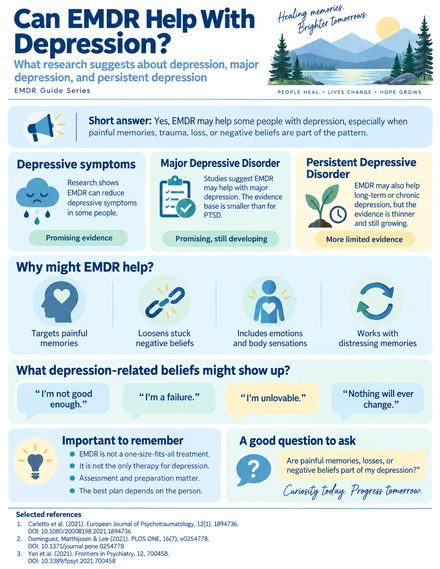
Can EMDR Help With Depression?
Can EMDR Help With Depression? separates findings for depressive symptoms, MDD, and PDD. Use the visual guide as a discussion aid, then read the accompanying evidence summary and references for the qualifications that a short graphic cannot fully convey.
Explain It Simply
EMDR is a structured therapy that can involve working with distressing experiences. Some studies suggest it may help with depression, but that research is smaller and less certain than the research for PTSD. Depression can involve many factors, and we would not assume that a difficult memory explains everything. We can look together at your goals, what you have already tried, and the options available. If we consider EMDR, we will discuss why it might fit and how we would review whether it is helping.
Question to Bring Into Session
What would you want to understand about the evidence and alternatives before deciding whether a treatment feels right for you?
From EMDRdot
The Research & Resources Center brings together eleven educational guides with readable web pages, selected references, and PNG and PDF downloads. You can browse introductions, preparation questions, common myths, and research topics without an account. EMDRdot's browser-based visual bilateral stimulation remains a separate tool intended to support clinician-directed sessions; these educational resources do not make a claim about the product's treatment effectiveness.
Explore the Resource CenterReferences
- Carletto, S., et al. (2021). Eye movement desensitization and reprocessing for depression: a systematic review and meta-analysis. European Journal of Psychotraumatology, 12(1), 1894736. doi:10.1080/20008198.2021.1894736Systematic review and meta-analysis
- Dominguez, S. K., Matthijssen, S. J. M. A., & Lee, C. W. (2021). Trauma-focused treatments for depression. A systematic review and meta-analysis. PLOS ONE, 16(7), e0254778. doi:10.1371/journal.pone.0254778Systematic review and meta-analysis
- Yan, S., et al. (2021). The Effectiveness of Eye Movement Desensitization and Reprocessing Toward Adults With Major Depressive Disorder: A Meta-Analysis of Randomized Controlled Trials. Frontiers in Psychiatry, 12, 700458. doi:10.3389/fpsyt.2021.700458Meta-analysis of randomized trials
EMDRdot educational content is provided for general information and professional education. It does not replace individualized assessment, clinical judgment, professional supervision, or treatment by an appropriately qualified healthcare professional.