Clients + Clinicians · Session Tools · Phase 3 · 3 min
Understanding SUD and VOC
SUD and VOC answer different questions. Neither is a diagnostic test, a readiness score, or a grade.
Awaiting qualified clinical review. Educational reference; not a protocol, formal training, supervision, or individualized treatment.
Why this matters
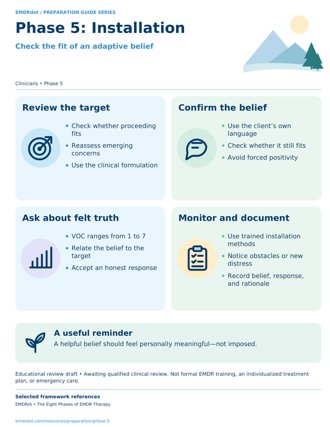
Clear scale language helps prevent confusing disturbance with the felt truth of a positive belief.
Client-facing explanation
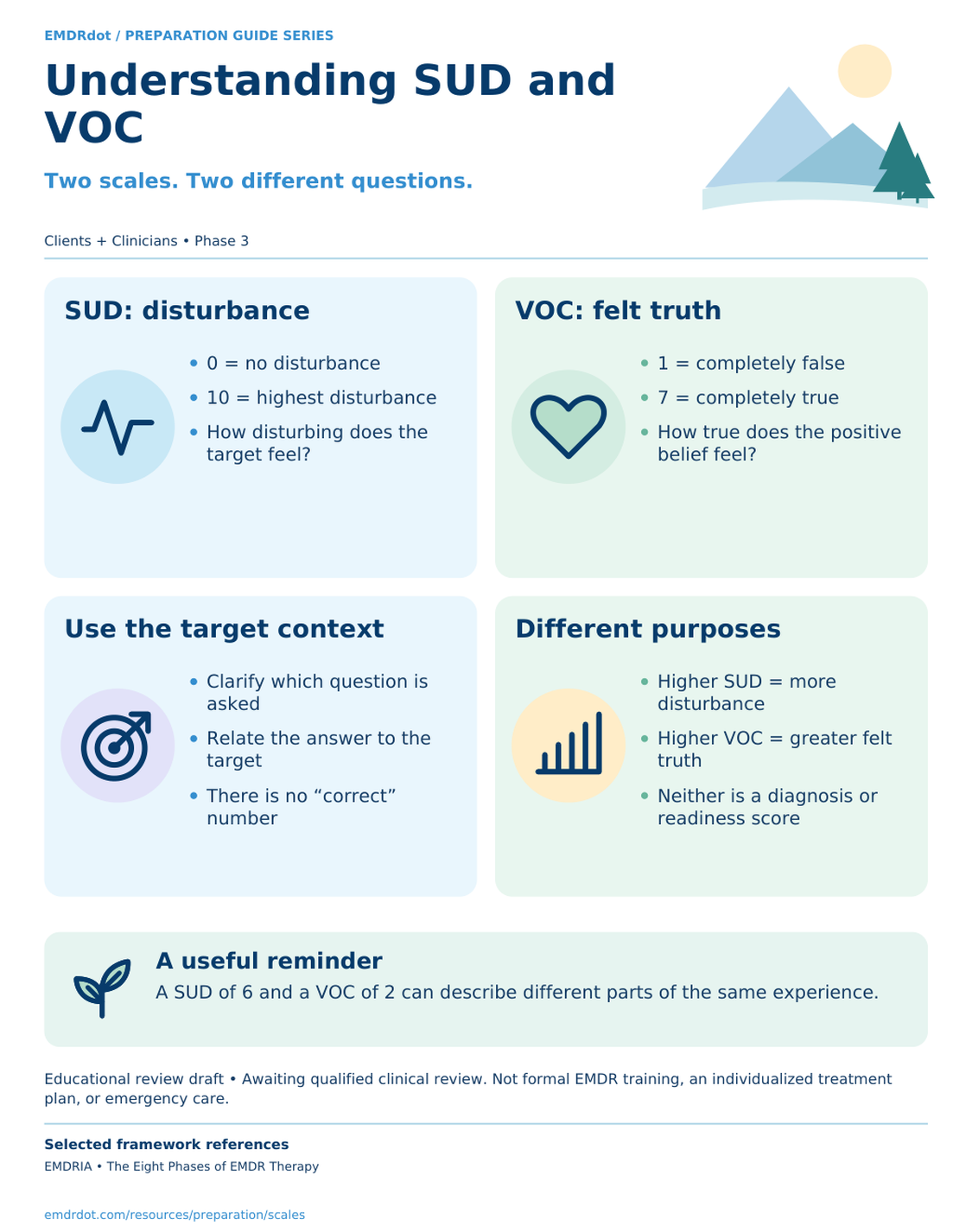
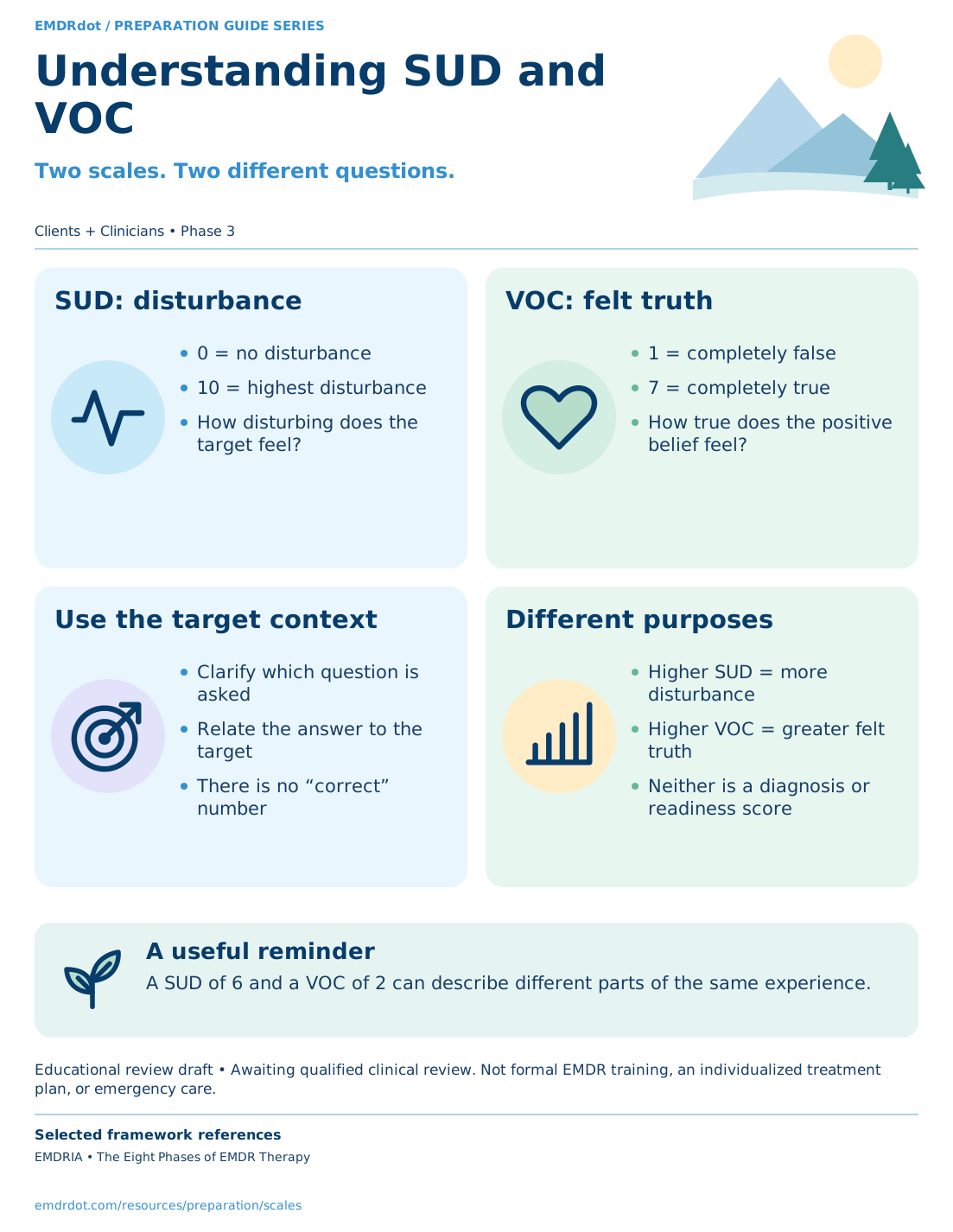
For SUD, a higher number means more disturbance. For VOC, a higher number means a helpful belief feels more true. You can ask your therapist to explain either scale again.
Clinician reference
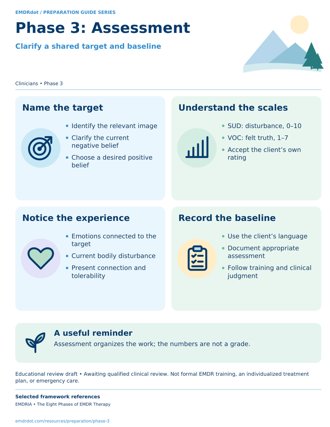
SUD: 0–10 subjective disturbance linked to the target in the current assessment context, from no disturbance to highest disturbance. VOC: 1–7 felt truth of the desired positive cognition in relation to that target, from completely false to completely true. Ask consistently, accept the client’s number, and interpret in context.
General sequence and discussion checklist
Optional discussion aid. Selections clear when you leave; this does not assess clinical readiness.
Practical example / documentation consideration
Fictional demonstration: SUD 6 and VOC 2 can coexist because the scales measure different experiences.
Education only. Try a number without recalling a distressing memory. Examples remain on this page and are not recorded or uploaded. For live responses use the existing session controls.
SUD · Disturbance
How disturbing does the target feel now?
0 No disturbance → 10 Highest disturbance
No example selected
VOC · Felt truth
How true does the desired positive cognition feel in relation to the target?
1 Completely false → 7 Completely true
No example selected
References and evidence notes
These sources inform the framework and discussion. They do not independently validate these original exercises or establish that every preparation technique is necessary or effective for every client.
- EMDRIA: The Eight Phases of EMDR Therapy
Framework and phase descriptions; does not validate these original worksheets.