EMDRdot
Start Session
Menu
Skip to content

Clinicians · Eight-phase Reference · Phase 3 · 3 min

Phase 3: Assessment

Establish a shared target assessment according to the clinician’s training.

Awaiting qualified clinical review. Educational reference; not a protocol, formal training, supervision, or individualized treatment.
Suggested use: preparation and shared discussion. No qualified clinical review date has been recorded.

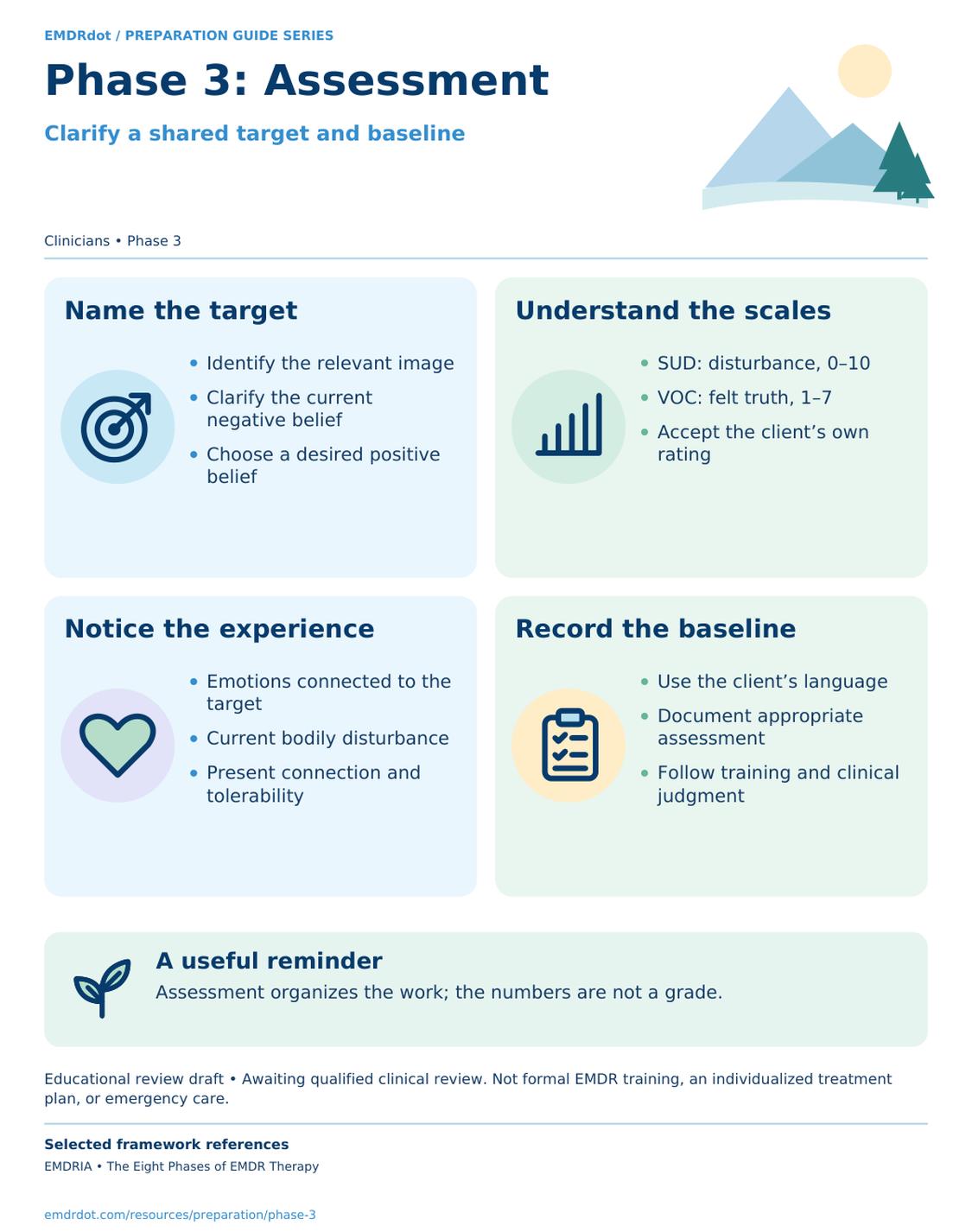
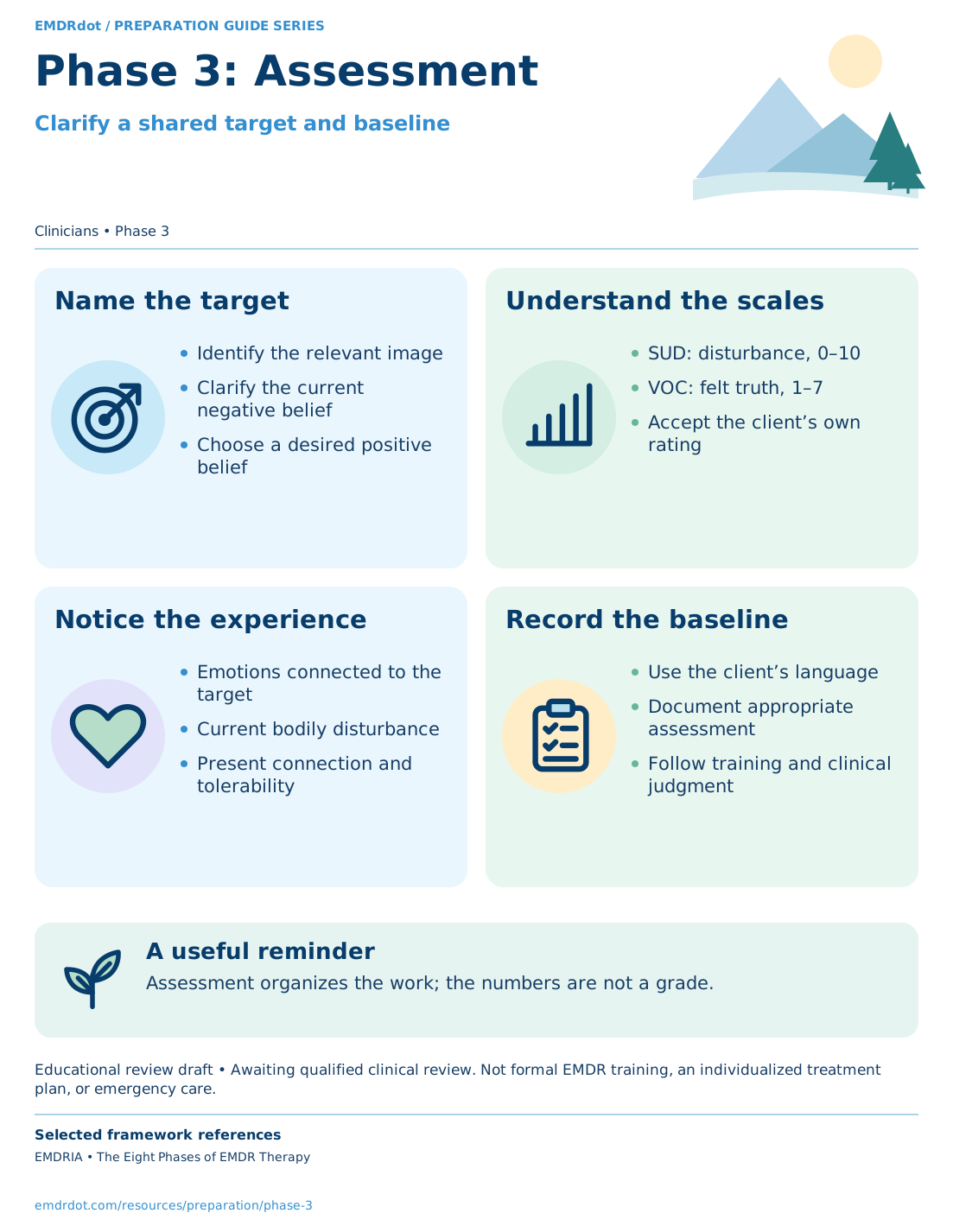
Phase 3: Assessment: Name the target: Identify the relevant image; Clarify the current negative belief; Choose a desired positive belief. Understand the scales: SUD: disturbance, 0–10; VOC: felt truth, 1–7; Accept the client’s own rating. Notice the experience: Emotions connected to the target; Current bodily disturbance; Present connection and tolerability. Record the baseline: Use the client’s language; Document appropriate assessment; Follow training and clinical judgment
Original educational visual. Read the full explanations and cautions below.
Enlarge infographic ↗

Why this matters

Clarify the target image, current negative cognition, desired positive cognition, VOC, emotions, SUD, and bodily disturbance as appropriate.

Client-facing explanation

We identify what we are working on and how it feels now; the ratings are your own experience, not a test.

Clinician reference

What feels most relevant about this target today? What words fit your current belief and your desired belief?

General sequence and discussion checklist

Optional discussion aid. Selections clear when you leave; this does not assess clinical readiness.

Practical example / documentation consideration

Documentation considerations: Record target identifiers, baseline ratings, client language, and rationale without unnecessary detail.

References and evidence notes

These sources inform the framework and discussion. They do not independently validate these original exercises or establish that every preparation technique is necessary or effective for every client.

Related resources

Clinicians · English

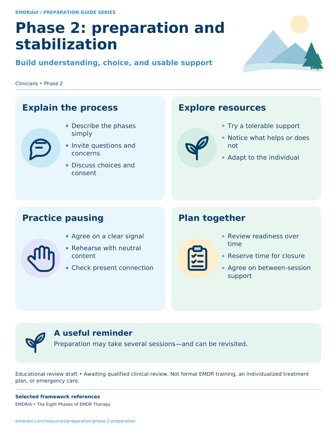
Phase 2: preparation and stabilization

Explain the treatment, establish shared control, and develop resources the client can actually use. Preparation may take several sessions and may be revisited.

Stabilization and Resourcing · Phase 2 · 3 min

Suggested use: professional discussion reference.

Clients + Clinicians · English

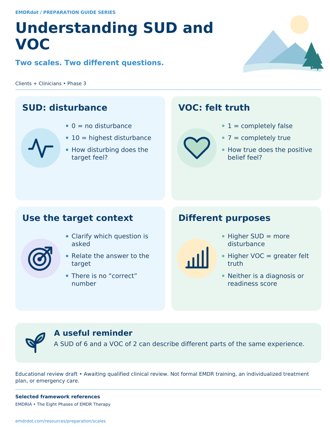
Understanding SUD and VOC

SUD and VOC answer different questions. Neither is a diagnostic test, a readiness score, or a grade.

Session Tools · Phase 3 · 3 min

Suggested use: shared discussion with a therapist.

Clinicians · English

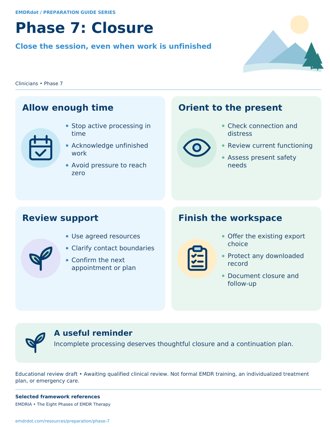
Phase 7: Closure

End each session with attention to orientation, present needs, and support, including when processing is incomplete.

Eight-phase Reference · Phase 7 · 3 min

Suggested use: professional discussion reference.

← Preparation center

EMDRdot educational materials are provided for general information and professional education. They are not a substitute for diagnosis, individualized treatment, clinical supervision, or emergency care. Treatment decisions should be made with an appropriately qualified healthcare professional.