EMDRdot
Start Session
Menu
Skip to content

Clinicians · Printable Materials · Phase 1 · 3 min

Target preparation and planning worksheet

A blank planning aid for a protected practice record, not a form for entering clinical information into the resource library.

Awaiting qualified clinical review. Educational reference; not a protocol, formal training, supervision, or individualized treatment.
Suggested use: preparation and shared discussion. No qualified clinical review date has been recorded.

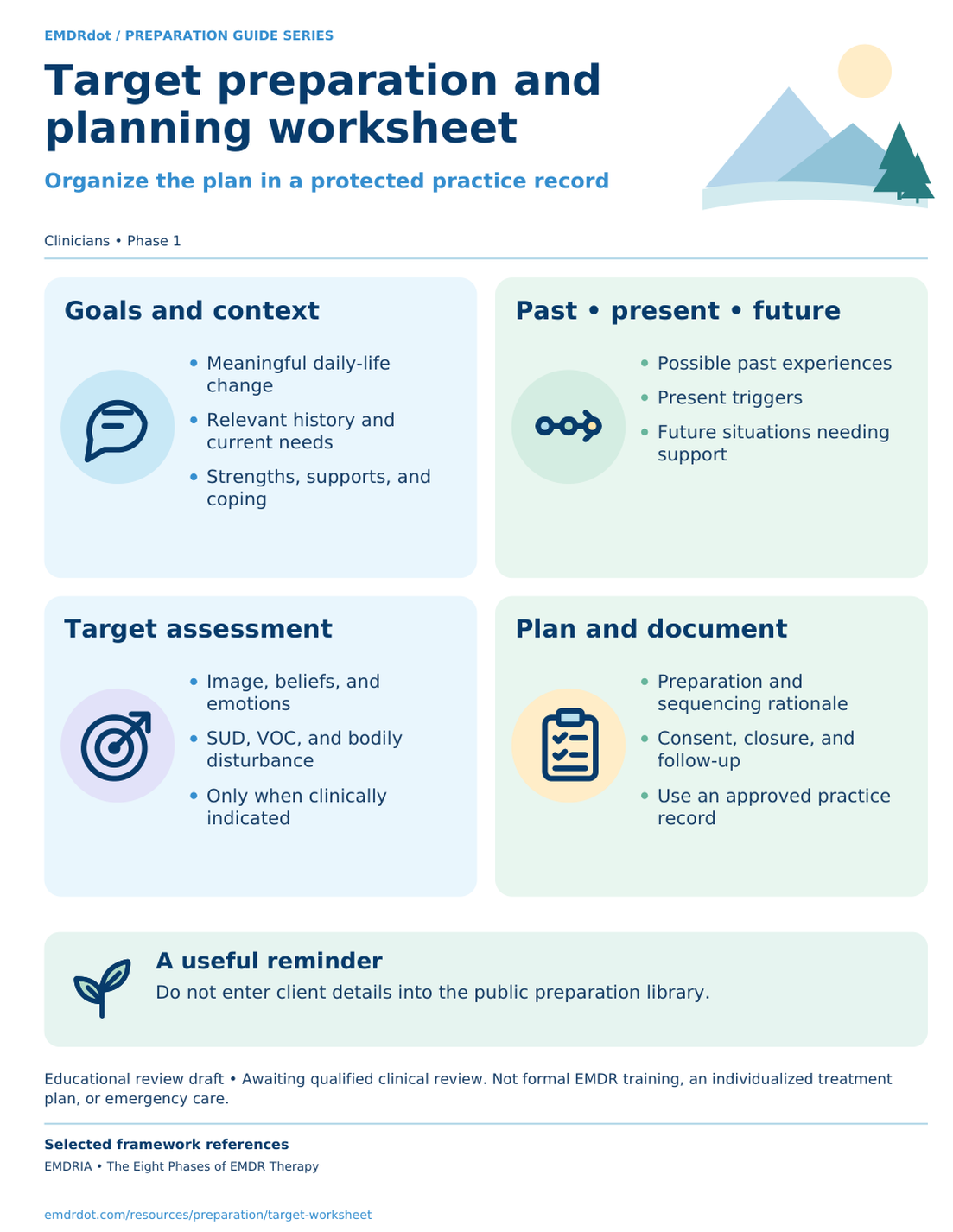
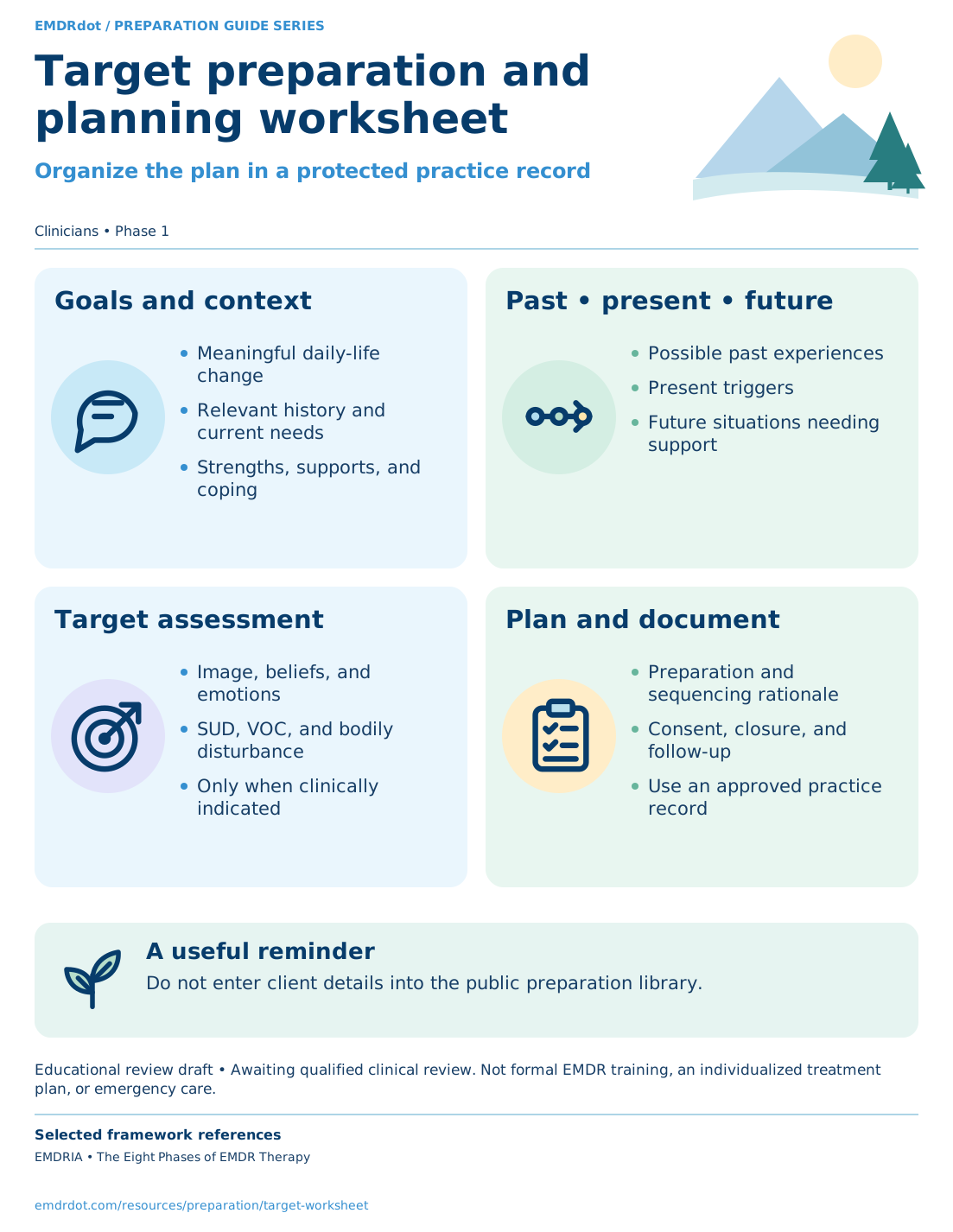
Target preparation and planning worksheet: Goals and context: Meaningful daily-life change; Relevant history and current needs; Strengths, supports, and coping. Past • present • future: Possible past experiences; Present triggers; Future situations needing support. Target assessment: Image, beliefs, and emotions; SUD, VOC, and bodily disturbance; Only when clinically indicated. Plan and document: Preparation and sequencing rationale; Consent, closure, and follow-up; Use an approved practice record
Original educational visual. Read the full explanations and cautions below.
Enlarge infographic ↗

Why this matters

Separating formulation from target assessment can keep planning collaborative and avoid premature activation.

Client-facing explanation

Your therapist will help decide what to focus on and how to pace it. You can say if a possible target feels unclear or too much today.

Clinician reference

Consider goals, possible past experiences, present triggers, future situations, sequencing rationale, strengths, stabilization needs, and consultation needs. Complete target assessment elements only when indicated and within training.

General sequence and discussion checklist

Optional discussion aid. Selections clear when you leave; this does not assess clinical readiness.

Practical example / documentation consideration

Use the downloadable blank worksheet in an approved clinical documentation system. This page has no patient-entry fields.

References and evidence notes

These sources inform the framework and discussion. They do not independently validate these original exercises or establish that every preparation technique is necessary or effective for every client.

Related resources

Clinicians · English

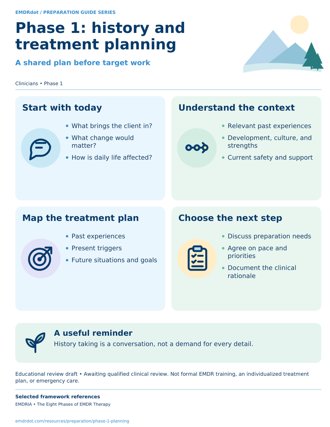
Phase 1: history and treatment planning

Build a collaborative formulation before choosing targets. History taking is paced to the person; it is not a request for a detailed account of every traumatic experience.

Preparation · Phase 1 · 3 min

Suggested use: professional discussion reference.

Clinicians · English

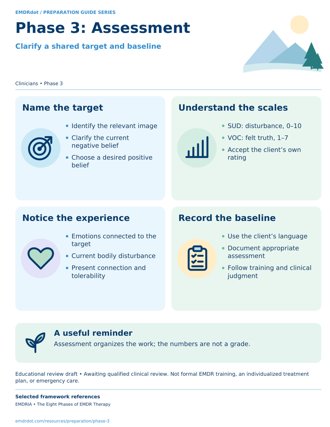
Phase 3: Assessment

Establish a shared target assessment according to the clinician’s training.

Eight-phase Reference · Phase 3 · 3 min

Suggested use: professional discussion reference.

Clinicians · English

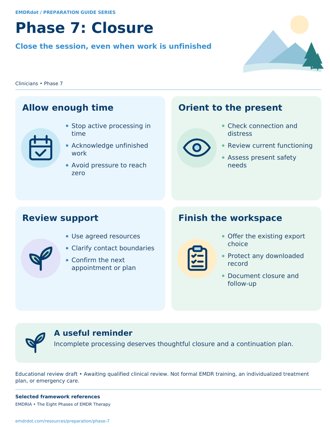
Phase 7: Closure

End each session with attention to orientation, present needs, and support, including when processing is incomplete.

Eight-phase Reference · Phase 7 · 3 min

Suggested use: professional discussion reference.

← Preparation center

EMDRdot educational materials are provided for general information and professional education. They are not a substitute for diagnosis, individualized treatment, clinical supervision, or emergency care. Treatment decisions should be made with an appropriately qualified healthcare professional.